
AppsFlyer is too big to let fail
Axios reports that mobile measurement platform AppsFlyer has raised more than $1BN from a consortium of four investors: Meta, Google, Unity, and Moloco. The investment is being characterized as a Series E round of financing, bringing the firm’s valuation to $2.7BN. AppsFlyer raised $210MM Series D in January 2020, led by the PE firm General Atlantic. Apple’s App Tracking Transparency (ATT) privacy policy was announced six months later, at WWDC 2020; it likely led to a significant cut in the company’s valuation. Rival measurement platform Adjust was acquired by AppLovin in 2021 for a reported $1BN.
A blog post from AppsFlyer’s CEO asserts that the terms of the investment prevent any single company from influencing the logic of AppsFlyer’s core attribution product. From the post (emphasis mine):
What this means in practice is simple. No investor receives preferential treatment in AppsFlyer’s APIs, measurement signals, attribution logic, or commercial terms. Our customers continue to control which partners they work with and the permissions and access they grant each of them, exactly as they do today. AppsFlyer is structurally independent, with backing by investors across the ecosystem …
And in a rapidly changing industry, the things that do not change matter most. We call them our invariants: (i) Customer obsession, (ii) Security and privacy, (iii) Data accuracy, and (iv) Enabling ecosystem innovation. They guided AppsFlyer through every major shift in the ecosystem, and they remain the foundation of everything we build. They are exactly where they have always been.
Bloomberg reported in June 2024 that AppsFlyer had recruited banks to pursue an IPO. In August 2025, Calcalist reported that the company was in talks to be acquired by private equity firms for $3.5BN; in March of this year, the same outlet reported that advanced talks to sell the company to Apollo and Fortissimo at a $1.9BN valuation had collapsed.
Mobile measurement platforms are often denoted as Mobile Measurement Partners, or MMPs; the provenance of that term is that Meta (then, Facebook) created the MMP program to establish a small number of firms as being officially authorized to interface with its measurement API to attribute app installs. I provide a brief history of app install attribution in The coming war between Apple and Facebook, published in January 2017, and the MMP program specifically in Why aren’t MMPs included in Apple’s Required Privacy Manifests SDK list? (see also the App Tracking Transparency Codex for more context). The full list of official MMPs can be found here; of these companies, AppsFlyer is almost certainly the largest, with Adjust, which is owned by AppLovin, likely the second-largest.
That context helps to explain why Meta, Google, Moloco, and Unity would want to invest in AppsFlyer. If AppsFlyer’s existing investors were unwilling to transact at the $1.9BN valuation discussed in the failed Apollo / Fortissimo negotiations, then the company, which is profitable on roughly $500MM in ARR, might have been acquired by a buyer that would have jeopardized its core operating neutrality. In this way, these companies are likely investing in AppsFlyer to allow its previous investors to cash out while also ensuring that AppsFlyer maintains its independence, such that their own interests are protected.
The Panic of 1907 occurred when a failed attempt to corner the stock of the United Copper Company triggered bank and trust company runs, threatening the stability of the US financial system. In response, the banker John Pierpont Morgan organized a rescue syndicate of National City Bank, First National Bank, and other large New York banks. The syndicate pooled funds to support the most vulnerable firms, including the Trust Company of America and Moore & Schley. The crisis highlighted the need for a formal lender of last resort and led directly to the creation of the Federal Reserve System in 1913; it is often cited as an early example of the “too big to (let) fail” phenomenon, although that phrase wasn’t coined until 1984.
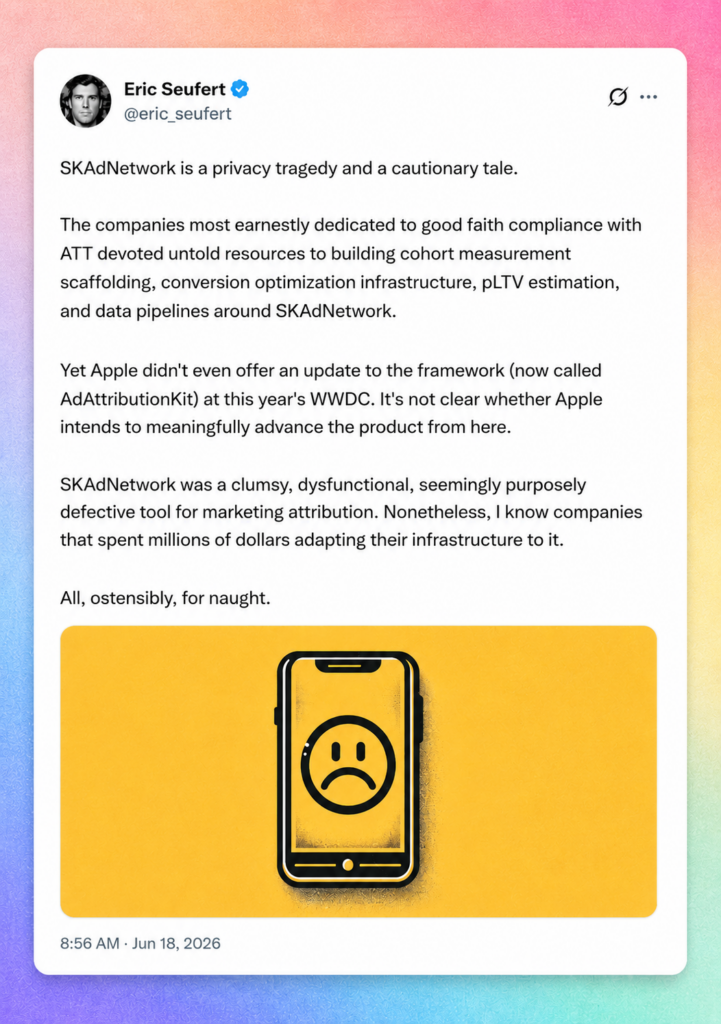
AppsFlyer is too big to let fail. Had AppsFlyer been sold to an acquirer that didn’t value attribution neutrality, the mobile app ecosystem would have been compromised. Because AppsFlyer sits at the center of measurement workflows for a substantial portion of the app ecosystem, its neutrality is arguably more important than that of any other independent infrastructure provider in mobile advertising. This is especially poignant now, just weeks after Apple’s WWDC conference, in which Apple didn’t even provide an update on its AdAttributionKit (AAK) framework.
In this sense, the transaction can be viewed as a form of defensive neutrality: ecosystem participants collectively paying to preserve the independence of a critical piece of shared infrastructure. Meta, Google, Unity, and Moloco seem to be treating AppsFlyer as an indispensable utility they can’t afford to see either degrade its service or be absorbed into an entity that could undermine its neutrality.
Comments: