
Distribution and the human attention premium

Evan Spiegel, Snap’s CEO, appeared on TBPN yesterday (see my recent appearance from last month here). In his interview, he made a point I’ve articulated a number of times: as AI-empowered tools rapidly diminish the time and effort required to produce content, and the pace and volume of content production therefore accelerate, distribution becomes the principal challenge facing content creators. From the interview:
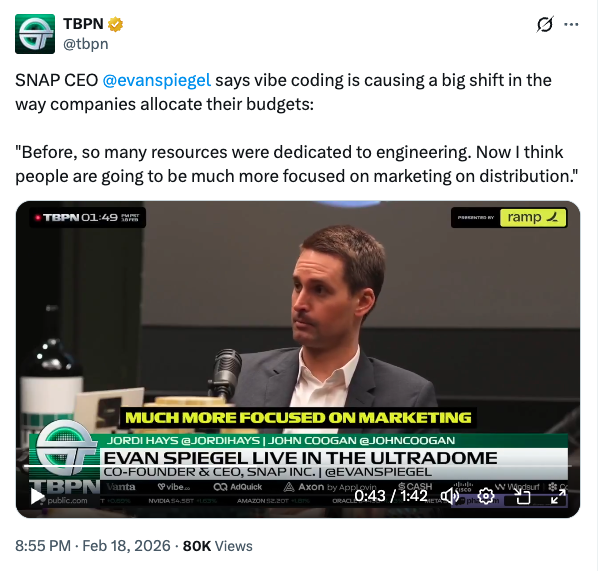
I think what’s going to be really interesting about all of these companies — before, so many of their resources were dedicated to engineering. Now, I think people are going to be much more focused on marketing, on distribution, and that’s a big shift.
That marketing and distribution become the principal challenges of scaling content in an attention landscape awash in it seems like an obvious outcome as production costs collapse. But it has not yet emerged as a coherent theme from the chaotic scrum of competing effects of AI on social media, technology more broadly, and even society as a whole. I touched on this in my recent analysis of AppLovin’s Q4 2025 earnings, as well as in World models, interactive entertainment, and the primacy of structure in game design. But to underscore the point, I’d revisit what I wrote in The inflationary impact of AI-generated ad creative, published in May 2023:
Generative AI is deflationary for content production but is inflationary for distribution. Generative AI will see the production costs of increasingly-complex forms of content (eg. video) approach zero; these tools will instigate an immense expansion in the volume of each content format that they perfect. The first photograph to feature a human being was taken by Louis Daguerre, inventor of the daguerreotype process, in Paris in 1838. According to The Guardian, as a result of widespread smartphone ownership, 1TN photographs were taken in 2014, representing more than a quarter of all existing photographs taken up until that point. Statistics like this will echo across text, animated and photorealistic video production, audio, etc. in synthetic form as a result of generative AI.
And as content proliferates through generative AI tools, the challenge of capturing potential customer attention becomes more acute — necessitating an increased reliance on advertising. This is inflationary: the corpus of content will grow at a much more rapid pace than the human birth rate. Organic discovery becomes ineffective as content mushrooms; this dynamic gave birth to the search ads mechanism in the first place. Generative AI will similarly create competitive friction for the discovery of all forms of content.
This dynamic is entirely consistent with the history of digital publishing tools, but it is unmistakable in the history of search, social media, and app stores. When content channels become saturated to the point that they overwhelm the availability of attention, discovery trends toward advertising. AI production tools will accelerate publishing across every possible content form factor, and the principal beneficiaries of that content expansion will be the companies that gatekeep discovery. Human attention will command a larger premium, and those gatekeepers — extant and yet to emerge — control its allocation.
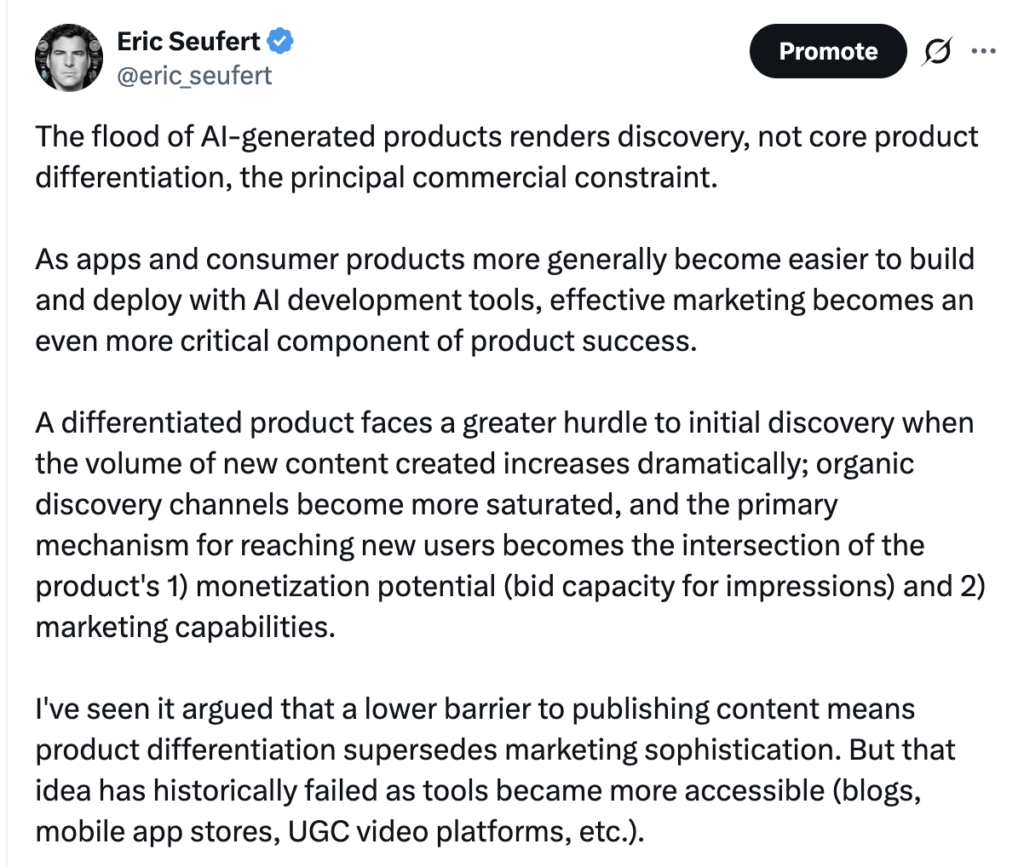
In The best and highest use of customer attention, I make the case that, in the digital context, human attention can be viewed as a raw, unrefined commodity and either sold in that way (advertising) or rendered into a value-added product (engagement), and the value of going in either direction can be quantified:
So how does a product operator determine the best and highest use of customer attention? For every marginal opportunity — every instance of user attention that can be served with either native content or an ad — the decision is fairly mechanical and analytical, dependent on estimated value that accounts for retention and expected revenue contribution.

I’ve seen it claimed that “taste” will be the determinant of success in an era of mass-produced AI content because it will allow for qualitative differentiation. I think the opposite is true: the analytical, sterile process of refining attention into a finished good (monetization) will dominate this new timeline, as it will facilitate distribution through marketing. That may be the antithesis of taste.
Comments: