
Understanding the privileged position of chatbot advertising

This week’s podcast episode is a long-form companion piece to an article I published last week: The privileged position of chatbot advertising. In this episode, I make the case for why the chatbot advertising model is differentiated from those of both search and social media, feed-based display, and why it benefits from greater targeting scope through the optionality and flexibility it can utilize in determining which signals should inform that targeting, based on the context of a conversation.
Articles cited in this piece:
- OpenAI’s advertising opportunity
- Google’s Gambit and Google’s Gambit, Part 4: The end of Static Search
- Obviously, OpenAI will monetize with ads
- Digital Advertising, Demand Routing, and the Millionaires’ Mall
- Search is the wrong mental model for chatbot advertising
- The prosperous society
Thanks to the sponsors of this week’s episode of the Mobile Dev Memo podcast:
- INCRMNTAL. True attribution measures incrementality, always on.
- Branch. Branch is an AI-powered MMP, connecting every paid, owned, and organic touchpoint so growth teams can see exactly where to put their dollars to bring users in the door and keep them coming back
Interested in sponsoring the Mobile Dev Memo podcast? Contact Mobile Dev Memo advertising.
The Mobile Dev Memo podcast is available on:
Transcript
This week, OpenAI announced that its ChatGPT advertising business has reached a $1 billion annualized revenue run rate. This is roughly 200 days after introducing ads into the product. ChatGPT ads are now available in more than 40 countries and are exposed to Plus subscribers and free users, with the free tier accounting for the vast majority of ChatGPT’s more than 1 billion weekly active users, as has been disclosed by the company.
The speed with which this business has become material provides an empirical point of reference for an argument I made last week in a piece titled, The Privileged Position of Chatbot Advertising. Under optimal conditions, the conversational chat-oriented interface possesses broader targeting scope than the other dominant consumer-facing digital advertising models. That privileged position derives from the variety and strength of signals available to a chatbot operator.
A chatbot can interpret commercially motivated context with greater semantic depth than a conventional one-shot search query since prompts can be long-form and intent can be refined over the course of a multi-turn conversation. But when a conversation contains no commercial locus, the chatbot can rely on advertiser-supplied off-platform behavioral data for targeting, much as a social media platform does for feed-based display ads. Context therefore expands the chatbot’s commercial opportunity without defining strict boundaries for it. This flexibility contains incredible commercial potential.
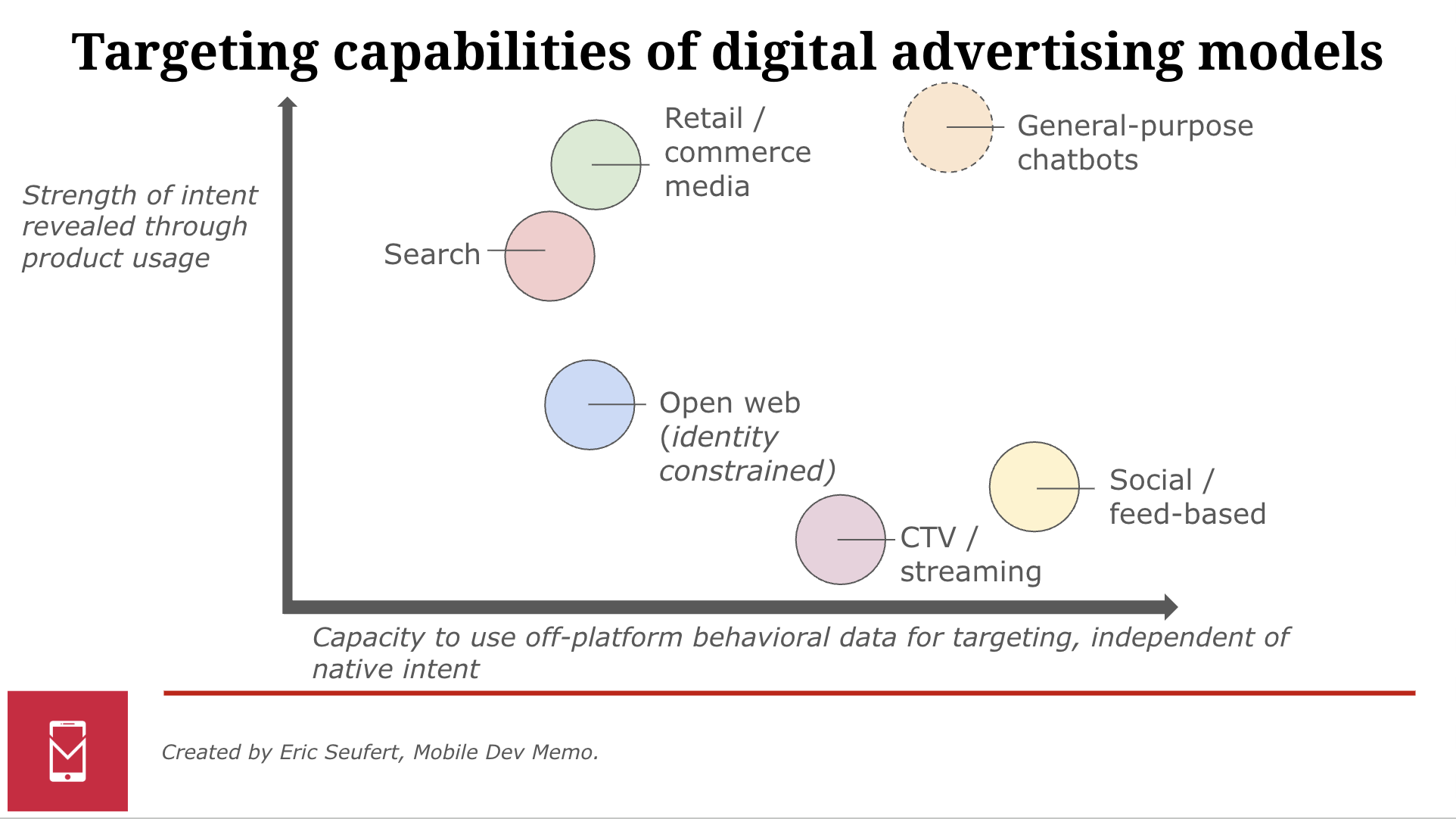
In the piece, I organized the dominant consumer-facing digital advertising models according to two dimensions. The first is the strength of intent revealed through ordinary product usage. How much commercially actionable information does the user disclose merely by using the product? The second is the platform’s capacity to use behavioral data generated elsewhere, including advertiser-supplied conversion events and customer lists, to inform targeting. Together, these dimensions describe a product’s targeting scope, which is its ability to monetize intent revealed natively through product usage or through behavioral signals collected outside the immediate product experience.
Search performs well on the first dimension because a query can contain an explicit and contemporaneous expression of intent, although that expression is usually compressed. Social media performs well on the second because its ad systems can predict receptivity from conversion data supplied through pixels and APIs, customer lists, and first-party signals like on-platform behavior and current session activity. Critically, the social media feed is a blank open canvas on which any product can reasonably be promoted, untethered from an underlying product category scope.
Search can also use off-platform data for retrieval, ranking, and bid setting, but keywords and related semantic signals constrain the commercial universe from which an ad is selected. Retail media occupies a powerful but bounded position because shopping activity reveals strong commercial intent, but explicitly within the retailer’s domain. Publisher and streaming media generally begin with attention to content, so their targeting depends more heavily on context and behavioral profiles assembled from elsewhere.
Two further distinctions enlarge the chatbot’s targeting scope. Unlike open-web publishers, a chatbot serves inventory that it owns, and it maintains a direct first-party relationship with the user. Unlike retail media, a general-purpose chatbot is not restricted to a particular category or merchant universe. A user can discuss almost any subject with the product, which means that ordinary usage always supplies some context, even when the conversation lacks an immediate commercial purpose. Given these differences, I defined chatbot advertising as a separate category in the piece. Quoting from the piece:
Conversation can reveal explicit, semantically valuable commercial intent, often refined across multiple turns. When such intent is absent, advertising can instead be targeted using first-party behavioral profiles and advertiser-supplied data ingested through advertiser tools like pixels and APIs. The native targeting object is therefore either the conversational task or, in the absence of commercial intent, the ad-user pairing. In effect, chatbot advertising has the potential to marry the commercial characteristics of social media display and search. It can present an ad that is relevant to context when that context is motivated by commercial intent, and it can revert to the off-platform behavioral data it receives to serve ads that are wholly unrelated to context when a conversation is not commercially grounded.
The meaningful distinction is between the conversational task and the ad-user pairing. Search is organized principally around the query or search session, whereas social media estimates receptivity at the user level. A chatbot ad system can navigate both, choosing the appropriate targeting objective for an eligible interaction and sometimes using the conversation to establish a broad semantic neighborhood within which behavioral data can rank candidate ads. The chatbot’s advantage is the optionality and flexibility to adapt to the moment. The ad system can adhere to the context of the session without allowing that context to impose a rigid boundary on the commercial universe available to it.
I used a Disney World example in another piece, OpenAI’s Advertising Opportunity, to illustrate how superficially different prompts can reflect the same underlying objective. Consider these queries: ‘Hotels on monorail Disney World August 2025’ and ‘How can I get back and forth to Disney World without a car?’ The first presents a clear commercial intent and is readily monetizable through conventional search advertising. The second expresses a practical, information-oriented question with vague commercial implications that require interpretation, since the user may ultimately face connected hotel and transportation decisions within a vacation agenda.
A chatbot can develop that second prompt through conversation. It can ask where the user plans to stay, whether children are traveling, how long the trip will last, and what tradeoffs the user is willing to make between convenience and price. Those answers clarify the objective and create a richer representation of the user’s actual need. The commercially relevant unit is consequently the session, and maybe even a sequence of sessions over time, rather than the opening prompt, because intent can emerge through the process of resolving an initially ambiguous request.
Google has described precisely this dynamic in AI mode. In an interview on this podcast, Google’s Vice President of Ads said that the company was finding opportunities to monetize longer conversational exchanges because they provide more context for identifying commercial intent and stronger signals for its advertising systems. Alphabet later explained on its Q1 2026 earnings call that AI overviews and AI mode had expanded their ability to serve ads on longer, more complex searches that were previously difficult to monetize. The proportion of opening queries that contain obvious commercial intent may remain limited, while the proportion of complete sessions that develop commercial value increases.
The distinction I developed in my Google’s Gambit series is anchored to the difference between legacy search as a distribution mechanism and the emerging AI-enabled transformed search experience as an engagement sink. Traditional search is designed to identify a useful destination and send the user there with a single click, whereas a chatbot retains the user’s attention while resolving their need within the product itself. I described the economic significance of that transition this way in the original Google’s Gambit piece, published in October 2024. Quote:
As a distribution mechanism, Google optimizes to generate one click per search. A user considers a search query successful if it leads to a click to the appropriate destination from the first page of results. But the incentive with AI overviews is very clearly different. It is to solve the user’s needs without leading to a click, potentially while instigating further queries and therefore increased time spent with AI overviews. Ads are displayed each time AI overviews are rendered, potentially leading to one click per query as a user refines their search. In effect, with AI overviews, Google can capture the conversions and ad clicks that occur subsequent to a successful search query in the current distribution mechanism configuration.
This transformation from a distribution mechanism to an engagement sink necessarily changes the commercial surface of the product. A successful legacy search terminates the interaction by distributing the user to a website, where subsequent commercial opportunities accrue at the destination. A conversational product retains those opportunities because the user continues refining their request inside the same interface. Each turn also provides additional information about preferences and effectively contributes to targeting, allowing ad relevance to improve as the session progresses. Google has transformed search in this direction through AI overviews and AI mode, while OpenAI is approaching the same structure from the opposite direction by adding a sophisticated advertising system to a product that was already an engagement sink.
But the shared text input interface obscures a material difference in the user-facing product proposition and monetization surface of a chatbot and a search engine. A search-style model encourages the operator to map an ad to a discrete query and to constrain ad retrieval through keywords or closely related semantic concepts within things like broad match. A chatbot can defer ad selection until the user’s objective becomes clear and present an ad once the conversation acquires commercial significance. When the subject provides little commercial value, the system can apply behavioral targeting within a much broader relevance boundary established over past interactions or through things like demographic features and device types. In effect, a chatbot can pick and choose how it targets ads to adapt to the presence or absence of underlying commercial intent.
I described this hybrid structure in “OpenAI’s advertising opportunity” before OpenAI had introduced advertising. Quoting from that piece:
The hub and spoke social media advertising model might better serve chatbots than the search advertising model. Social media advertising detaches the context of a user’s session from targeting, with each scroll being an opportunity for a new impression. Unlike search engines, chatbots aren’t bound by the immediate necessity of finding a link for a user to click to facilitate content discovery. With a chatbot, each query is an opportunity to serve an ad, and targeting doesn’t need to be anchored to the content of that query unless it carries clear commercial intent. Chatbots can marry the best aspects of social media display and link-based search advertising models to create advertising opportunities with each query.
Here I’m describing the commercial surface available to a chatbot operator, although product design still determines which eligible interactions should carry an ad. That piece also identified the infrastructure OpenAI would need to activate the opportunity: a pixel and conversion API for ingesting advertiser outcomes, along with the optimization and measurement systems required to convert those outcomes into targeting signals. OpenAI has since launched those tools, as well as self-service campaign management, custom audiences, conversion optimization, app install attribution, and advanced matching. These products give OpenAI access to targeting and outcome signals beyond the content of individual conversations. Its advertising platform increasingly resembles Meta’s in its campaign management and data ingestion tools, even though the ChatGPT ad surface can access a form of native intent that a social feed generally cannot.
What I called the privileged position of chatbot advertising is a structural claim about commercial opportunity under optimal conditions. The value that materializes from these platforms still depends on scale, auction liquidity, measurement efficacy, advertiser adoption, and expert product execution. But this necessary performance foundation has taken shape in multiple places. Again, ChatGPT has reached $1 billion in annualized revenue run rate with advertising in less than a year. AI overviews has 2.5 billion monthly users and Google has stated that it monetizes at parity with legacy search. One could dispute the idea that AI overviews is a chatbot, but AI mode has 1 billion monthly users. The scale exists and the revenues are real. The opportunity with chatbot ads is no longer hypothetical.
The relationship between ChatGPT’s revenue and reach hints at how immature this monetization mechanism may be. One billion dollars of annualized advertising revenue against more than 1 billion reported weekly users represents under $1 of blended annualized advertising revenue per weekly active user. A formal ARPU calculation would require matching the numerator with a denominator within some defined time interval. The rough ratio nevertheless reveals very low monetization density across the reported audience, which has expanded recently with OpenAI opening ads to 31 new countries on August 24th and making its self-serve platform available in more than 40 countries on August 31st. This leaves considerable scope for growth with a mature advertising product.
Google provides the most useful guidance between the structural argument and the available commercial evidence. Alphabet disclosed that search queries reached an all-time high in Q1, while search revenue grew by 19.1% to $60.4 billion. In Q2, search revenue grew by 16.8% to $63.3 billion. Google also said that 500,000 advertisers had adopted AI Max, its optimization layer for search and shopping campaigns, and that the product was unlocking billions of net new searches that had previously been difficult to monetize. These disclosures do not identify AI mode as the isolated causal source of search revenue growth. Search revenue is reported in aggregate, and Google attributed the Q2 results to multiple parts of the business working together, with Gemini integrated across ad quality and advertiser tools as well as the new AI experiences. But the combination of record query volume in the previous quarter, strong double-digit search growth, broad AI Max adoption, and newly monetizable searches makes the simple cannibalization thesis difficult to sustain. AI-generated answers were expected to reduce search engagement and displace advertising revenue. Google is reporting more queries while expanding the set of searches against which its ad systems can operate.
The result follows the transformation described in the Google’s Gambit series. In the fourth installment, The end of Static Search, I framed the commercial opportunity this way:
The commercial opportunity as search converges to a hybrid chatbot interface is fairly obvious: more queries, more ad exposures per search session given the conversational nature of chatbot engagement, and more direct integrations into checkout. This has been the thesis of my Google’s Gambit series: that transforming search from a discovery channel to an engagement channel would pull the commerce opportunities it previously facilitated into the product experience itself.
Google has defended its search franchise by changing what search is. I’ve called the transition to AI overviews and AI mode a total Ship of Theseus transformation of the product. The static legacy product distributed a user to a destination where commercial activity continued, while AI overviews and AI mode retain the user as the objective is refined and can integrate the resulting commerce opportunities directly into the experience. Google is making search conversational while OpenAI is making conversation commercial. Viewed together, the incumbent, Google, and its challenger are converging on the same advertising interface from opposite directions.
OpenAI’s product velocity provides additional evidence that this interface can support a functioning performance advertising market. In May, the company introduced a self-service ads manager, CPC bidding, a pixel, and a conversions API. Those products allowed advertisers to measure purchases and other downstream events, although campaigns could not yet optimize delivery against the events being measured. The initial system could calculate the cost of conversion while advertisers still bought on a CPM or CPC basis. By July, OpenAI had introduced custom audiences and oCPC conversion optimization, allowing advertisers to use customer lists for targeting and optimize delivery towards users predicted to complete a selected conversion event. It also added app install attribution through AppsFlyer and Adjust, automatic advanced matching, a bulk API, and a refreshed format for product feed campaigns. By August, OpenAI reported that CPC and outcome-optimized bidding represented the majority of campaigns. The progression from measurement to optimization occurred within one quarter, and it indicates that the early limitations of the advertising product reflected its stage of development rather than a persistent ceiling on what the platform could support.
These products form the performance loop in which the chatbot converts attention into scalable advertising revenue. Targeting determines which ads enter an auction, conversion measurement identifies the outcomes produced by those ads, attribution connects outcomes to campaigns, and optimization uses that feedback to improve subsequent delivery. Better expected returns allow advertisers to reinvest, generating additional observations with which the platform can improve its predictions. The revenue figure is meaningful because this machinery is being assembled at an impressive clip, with an obvious roadmap of improvements still available.
I published some napkin math in April after OpenAI disclosed that ChatGPT ads had reached a $100 million annualized run rate to estimate what a global expansion might produce. Using rough comparisons with the geographic ARPU distribution and free tier usage of other large advertising platforms, I estimated that switching ads on globally for all free users could generate just over $1 billion in annual revenue. OpenAI’s recently disclosed figure lands within that neighborhood, although there are differences in geographic availability and user eligibility from what I presented. Nonetheless, the path to $1 billion in annual revenue was certainly foreseeable.
The more important validation concerns the mechanism that I expected to produce continued growth. That April piece argues that a reported $60 CPM was unlikely to survive a dramatic expansion of supply and describes CPM as a reach strategy, whereas conversion optimization serves as an ARPU strategy. OpenAI has since introduced conversion-optimized delivery, and CPC plus outcome-optimized bidding already accounts for most campaigns. The path towards greater monetization density therefore depends on improving advertiser outcomes rather than sustaining a scarcity or novelty premium indefinitely.
The existence of a global audience and a functioning performance loop leads to the broader monetization argument I made back in May 2024 in Obviously, OpenAI will monetize with ads:
Hiring [Fidji] Simo represents such an on-the-nose acknowledgment of that fact that I almost didn’t write this piece. Except that OpenAI’s admission that advertising is its path forward on monetization serves to dispel a common misconception, really a fallacious superstitious tech dogma, that advertising is but one of many monetization strategies that are all equally capable of achieving optimal revenue for scaled consumer technology products. This isn’t true. If maximizing revenue is an organization’s objective function and its product can potentially reach a scale of billions of users, then advertising stands alone as its optimal monetization strategy.
A subscription establishes what users believe ChatGPT is worth, while an ad auction asks what a particular moment of user attention is worth to any firm capable of satisfying their addressable demand. Those mechanisms draw value from different payers. The subscription captures the user’s willingness to pay for the product, while advertising captures the willingness of firms to pay for access to an eligible commercial moment. For a scaled general-purpose consumer product with wide variation in willingness to pay, a very large non-paying or low-paying cohort, commercial relevance spread across many kinds of sessions, and the ability to preserve an ad-free premium option, a hybrid model can capture both pools of economic value.
I call the mechanism through which that advertiser value is created ‘demand routing.’ In Digital Advertising, Demand Routing, and the Millionaires’ Mall, which I published in February 2024 and consider MDM canon, I described it this way:
One challenge with optimizing for conversions is that in an ecosystem as vast and mostly heterogeneous as the internet, even in the context of a specific scale product, the presence at any given moment of a user that one, has an interest in some product, and two, possesses the disposable income to purchase that product, is rare. Digital advertising doesn’t create consumer demand; rather, digital advertising should seek to route existing demand to the products that best serve it. An efficient digital advertising channel matches consumer demand for a product with the most satisfying and fulfilling variant of that product. An advertising channel is not a demand factory, but a demand highway. The more efficiently an ad channel can route consumer demand to products, the more economic value it produces.
A chatbot can improve the interchange on that demand highway by helping the user articulate an objective and resolve constraints before an ad is selected. The richer expression of demand can improve expected advertiser returns because the platform has a more precise understanding of the need it is attempting to match. For performance advertisers, channel-level budgets can expand when absolute returns at the margin are attractive, since a channel that generates more profitable conversions supports further reinvestment. Better matching can therefore expand spending through improved economics, rather than moving a fixed pool of budget mechanically from search or social media.
This makes the opportunity larger than a transfer of advertiser revenue from Google to OpenAI. In The Prosperous Society, my four-part series on the economic promise of AI, I argued that AI weakens the production constraint. As the cost of producing products and content falls, distribution becomes the binding constraint on economic activity. Personalized digital advertising serves as coordination infrastructure by lowering the cost of matching increasingly specialized output with the narrower audiences that value it. Better targeting makes more product variety commercially viable, while AI-enabled advertising tools allow firms that were previously excluded from sophisticated demand generation to participate in that market. Greater participation and greater product variety can expand economic activity, which means that the next leg of digital advertising growth can be supported by the value the system creates, rather than by redistribution of a fixed volume of spending. Chatbot advertising certainly contributes to that system. Its architecture is sound, and the early economics provide evidence that it is becoming commercially meaningful.
While trust and privacy expectations may still shape the rate and limits of growth, those objections deserve to be evaluated against the actual design choices available to chatbot operators and not treated as systemic limitations or fundamental flaws in the model. The commercial opportunity does not eliminate product risk, and the scale of the category increases the consequences of poor execution. I framed that distinction in The privileged position of chatbot advertising this way:
This underscores the importance of getting chatbot ads right. The obvious tension that chatbot ads must navigate, and while it is obvious, I believe it is overstated, is the belief that any user’s conversation is being weaponized merely as an advertising delivery mechanism. I call this the AI search incentive problem. While empirically consumers do not view personalized advertising as adversarial or inimical to their interests, it’s conceivable that gratuitous ad units or relevant ad units placed within sensitive conversations could sour consumer attitudes towards chatbot advertising.
I characterize that outcome as avoidable through disciplined product design, which distinguishes it from a fundamental weakness in personalized advertising in chatbots. The principal product concerns involve answer integrity and trust. A separate commercial concern asks whether the users who receive ads represent an economically attractive audience in the first place.
The strongest version of the trust objection, which is entirely fair, should be taken seriously. A chatbot derives its utility from the user’s belief that its answers are being generated in service of their best interests. If an advertiser can alter those answers, or if the user reasonably believes that commercial considerations take priority over objectivity or editorial value, the assistant ceases to function as a trusted source of information. The categorical inference follows only by merging answer generation and advertising into one system. Answer generation produces the organic response, while a separate advertising mechanism can determine eligibility and rank a sponsored, clearly demarcated unit without allowing an advertiser to shape the content of the chat.
This distinction matters when the assistant recommends one product while a nearby ad promotes another. The sponsored unit can remain independently ranked rather than becoming the paid conclusion to the assistant’s analysis. The conversation can therefore serve as an input to ad selection without the advertiser becoming an input to answer generation. There’s no hard rule that says these two things must in practice be combined.
A disciplined serving hierarchy can protect that separation by excluding sensitive contexts before an ad is considered and permitting a contextually relevant sponsored unit outside the answer only where strong commercial intent exists. Where the interaction lacks commercial intent, a behaviorally relevant ad can be considered only if it clears the platform’s relevance and experience thresholds. That no-fill option is part of the privileged position I highlighted because the platform retains discretion over whether an interaction should be monetized at all.
The residual risk is real at the product level. A poorly timed ad can appear exploitative, an adjacent placement can imply an endorsement that the answer does not provide, confusing provenance can obscure the platform demarcations, and aggressive ad load can make the architectural separation feel cosmetic if not nonexistent. But these are design risks masquerading as a business model flaw. Careless implementation can damage an individual chatbot, but that possibility does not demand that advertising necessarily corrupt chatbot answers.
A second concern with respect to this explicit rift between content and advertising is that a user might feel surveyed if they are exposed to ads that are relevant generally but not to the conversation at hand. This objection concerns the apparent provenance of an ad rather than the integrity of the answer. A user discussing an unrelated subject may encounter an ad that is personally relevant and infer that the platform exposed a private conversation or constructed an unusually invasive dossier. If that inference recurs, the ad experience can damage engagement even when no conversation has been disclosed to an advertiser. I addressed that concern in Search is the wrong mental model for chatbot advertising:
I think it’s a mistake to view the search advertising model as the default for chatbots, both from a user expectation and a revenue standpoint. My sense is that users aren’t bothered if the ads aren’t relevant to their conversations, current or past, so long as they are relevant to them. They will be forgiving of wholly unrelated but interesting ads in ChatGPT and other chatbots. Google Search predates social media; consumers have grown accustomed to free ad-supported products. In many cases, consumers believe the provenance of the data used to target those ads is far more invasive and sinister than it is in reality.
I also think it’s overblown generally. Uber, Netflix, Spotify, Duolingo, and MyFitnessPal demonstrate that advertising can coexist with useful scaled consumer products, including products that handle personal data like location and health habits. Those examples offer no guarantee that every ad will feel appropriate and individual placements can still feel creepy. They establish that advertising itself does not prevent a consumer product from retaining utility or trust. The feeling of surveillance is more likely to arise when data provenance is unexplained or the inferred subject is sensitive.
The hybrid targeting model addresses those conditions without forcing every ad to mirror the active conversation. Context can determine whether an interaction is eligible and define a broad semantic neighborhood, while first-party behavioral data and advertiser-supplied signals rank candidates within that boundary. The conversation remains with the platform rather than being passed to the advertiser, and a user who disables broader personalization can leave the system with the current thread context only. Context can function as a guardrail while behavior functions as a ranking signal, avoiding both blind contextualism and unconstrained behavioral targeting. Bad inferences remain possible because users cannot directly observe the targeting system, so clear explanations and conservative treatment of sensitive interests remain an important part of the product experience.
My everything-is-an-ad-network thesis describes the economic potential created when a scaled product aggregates scarce attention and first-party context, then connects that inventory to advertiser demand. Access to suppliers can turn those inputs into an advertising marketplace, with ad load remaining specific to each product and its user experience. But that thesis is also, years after I articulated it, less hyperbolic than it may have seemed when I introduced it. Nearly everything is an ad network. It’s not clear why users would revolt against behaviorally targeted ads in chatbots and not anything else.
The adverse selection objection is the most commercially reasonable one in this discussion, although its premise may be narrower than is initially obvious. Ads currently appear to free and Plus users in ChatGPT, for example, while the higher-priced tiers remain outside the advertising pool, so the concern already extends beyond a strict free-users-only critique. If subscription status reliably captured purchasing power across the economy, this segmentation would produce a weaker audience and constrain advertiser bids, since only the lowest-appeal users would be addressable. But willingness to pay for ChatGPT is category-specific, and declining to buy ChatGPT Plus provides weak evidence about a user’s propensity to purchase travel, financial services, games, household products, cars, entertainment, or other subscriptions.
The ad-supported audience is also heterogeneous, encompassing occasional or light users alongside students and people satisfied by the product’s limits. Many of these users may simply prioritize other subscriptions. An ad-supported audience drawn from a product with more than 1 billion weekly users cannot sensibly be assigned one economic identity on the basis of a single observed purchasing decision. Subscription status reveals a preference about one product under one pricing regime. It is not a sufficient statistic for the user’s value to every advertiser that might bid for that person’s attention.
Free access can also produce engagement that a subscription-only product would never capture. Advertising allows a product with substantial compute costs and premium capabilities to carry a zero or low price, expanding distribution beyond the population willing to add another paid subscription. Zero price is not evidence of zero consumer value. In this case, it is a commercial design that allows an expensive product to remain broadly accessible, and a user may select the ad-supported tier because its access is sufficient while remaining valuable to firms selling unrelated products.
Campaign economics do not require every free or Plus user to possess equal value. Custom audiences allow advertisers to include or exclude known customer groups and apply bid multipliers to matched users, while conversion optimization directs delivery towards users with higher predicted conversion probability. In a mature auction, lower-expected-value opportunities can attract lower bids or receive less delivery. Some may fail to clear, while advertisers can exclude matched audiences or adjust their bids. Valuable subpopulations can support profitable campaign economics without requiring every available impression to carry the same price.
The millionaire’s mall logic applies because conversion value is fat-tailed and false positives are expected. Targeting must attenuate that skew enough for the cohort as a whole to be profitable, even when a small number of conversions accounts for most of its value. Low-value users therefore do not poison the entire inventory merely by being present within it. The residual risk is targeting failure. Valuable users may be too sparse or the platform may fail to identify them with sufficient precision. Custom audiences can segment known groups and adjust their bids while conversion optimization can concentrate delivery on users with higher predicted conversion probability. Again, these are design and execution solutions to narrow problems, and they undermine the notion of broad misalignment between advertising and the chatbot user experience.
This is not to downplay the scale of those design and execution challenges. They are substantial. Answer integrity must be protected and privacy choices must be meaningful, and sensitive context exclusions and ad quality controls must operate reliably. Measurement must be credible while advertiser integrations must be deep enough to support optimization. Auction liquidity, fraud prevention, frequency management, and ad load all require skilled product execution. These are not trivial considerations, and it is these constraints that determine how much of the opportunity can be captured and how quickly the market can develop. None of those demands removes the underlying combination of global reach, contextual intent, behavioral data, and adaptive presentation.
Google is transforming a distribution mechanism into an engagement sink, while OpenAI is equipping an engagement sink with the infrastructure of a performance advertising platform. ChatGPT’s $1 billion annualized revenue run rate provides an early proof point for that convergence, with ample room for monetization density to increase and the product to mature. That is the privileged position of chatbot advertising. The platform can choose between the task and the user as its targeting object while withholding the ad when neither provides an acceptable basis. Context is an asset, not a constraint, and the flexibility and optionality with which chatbots operate might be viewed as a best-of-both-worlds hybrid between the search and social display advertising markets.
Comments: