
ChatGPT launches a CAPI, a pixel, and self-serve

OpenAI announced changes to its advertising platform today, including a conversions API (CAPI) and a pixel to support conversion measurement, a self-serve ads management portal, and CPC bidding. From the blog post (emphasis mine):
We’re taking the next step in our ChatGPT ads pilot by making it easier for businesses to participate while keeping the experience useful, private, and clearly separate from ChatGPT’s answers. Advertisers can now create ChatGPT ads through partners or a new beta self-serve Ads Manager. We’re also introducing cost-per-click (CPC) bidding and expanded measurement tools, giving businesses more flexible ways to buy, manage, and understand campaign performance without sharing conversations or personal details with advertisers …
We recently launched Conversions API and pixel-based measurement so advertisers can better understand what happens after someone engages with an ad, such as a purchase, lead, sign-up, or other meaningful action.
I had a conversation with OpenAI’s advertising leadership about these changes yesterday: they noted that while this standard events library, combined with the new measurement tools, allows the cost of these conversion events to be calculated, those events can’t yet be bid against. So advertisers either bid on a cost-per-click (CPC) basis or buy traffic on a CPM basis, and individual event counts are reported. So CPC is the only conversion optimization being introduced — advertisers cannot optimize for the conversion events they measure in the new CAPI and pixel.
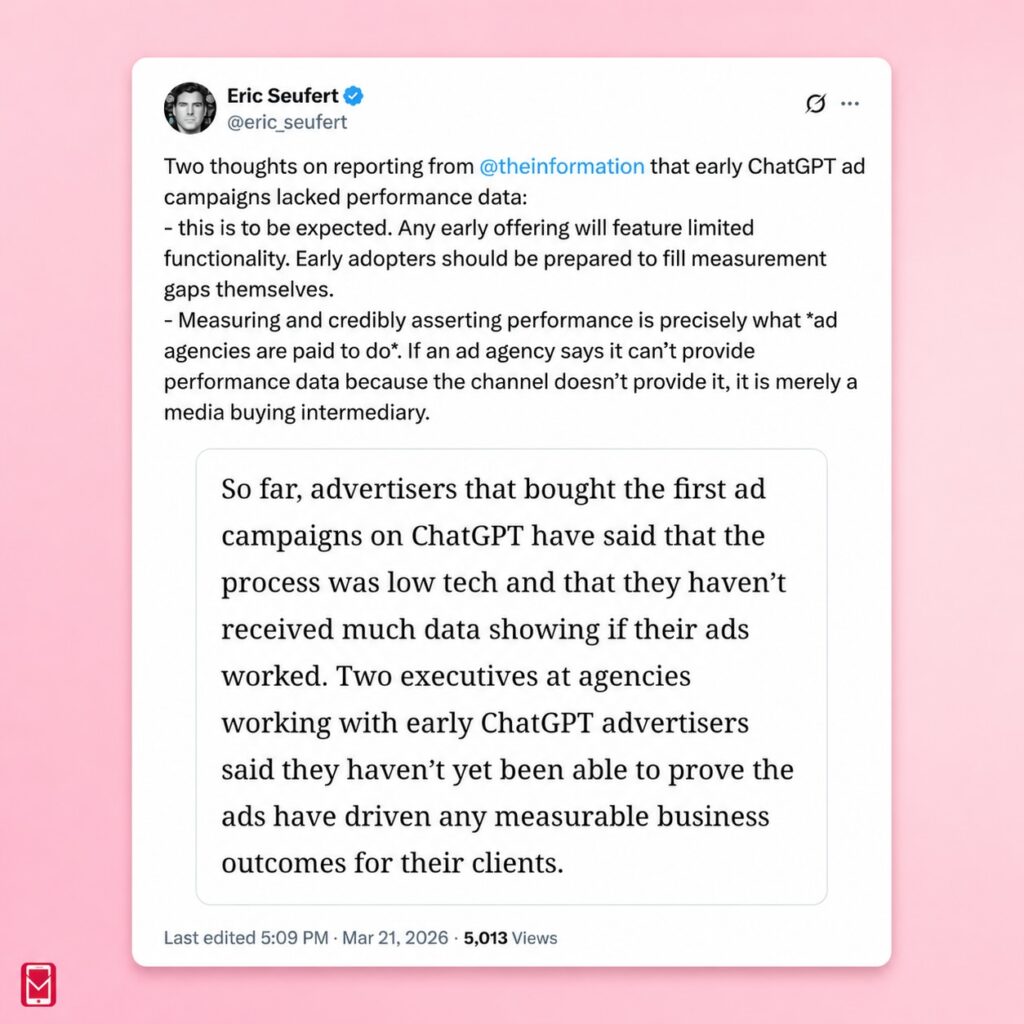
In OpenAI should know better, published just before OpenAI launched its advertising product, I argue that the primitive state of the initial product shouldn’t be seen as an indication of its revenue potential and that the velocity of improvements would be the real metric to watch in sizing the opportunity. From that piece:
OpenAI’s initial advertising offering resembles that of Perplexity, which seems to have either deprioritized or completely abandoned the project, and of Netflix, which was initially unsuccessful with the endeavor but eventually pivoted its strategy into something more workable. And yet, I do believe that OpenAI’s advertising initiative will be successful, and that this limited functionality (including CPM billing) will merely serve as a short-term stop-gap phase until the company can build out the tools and infrastructure it needs to deliver direct response outcomes to SMBs.
OpenAI should know better. And the team there likely does. If OpenAI’s advertising platform doesn’t evolve meaningfully in six to twelve months to include conversion-optimized targeting and vastly better measurement, I’ll be skeptical of its success. But until then, given the high density of ex-Meta employees working for the company, I’m willing to give OpenAI the benefit of the doubt.
It’s not hard to imagine how the ad platform evolves from here. OpenAI is almost assuredly building a platform in the image of Meta’s, which means it will cater the platform to the needs of SMBs, particularly eCommerce and retail advertisers. Given that premise, I’d imagine that OpenAI proceeds to introduce conversion-event bidding optimization, bid strategies, some sort of ROAS optimization (à la Meta’s Value Optimization), and, ultimately, an end-to-end automation product.
OpenAI has lofty ambitions for its advertising business; the state of the ad platform at any given point in time shouldn’t be mistaken for a fundamental limitation unless and until progress stops. This was the point I made in my most recent appearance on TBPN: we can assess (and possibly quantify) the eventual scope of ChatGPT’s advertising business in 12-18 months, when the core performance foundation is in place. What OpenAI does not lack is the user base scale, technical domain expertise, or money required to build a cutting-edge advertising platform. So early snapshots of functionality aren’t helpful proxies for what the platform will ultimately support.
Comments: