
Meta partners with Stripe for in-ad shopping

In a blog post published Tuesday, Stripe announced that it has partnered with Meta to bring on-platform shopping back to the Facebook app. But this implementation is different from the social commerce experience that Meta eliminated in June (see The retreat from social commerce); in this new configuration, users can purchase items directly from a Facebook ad. From the blog post (emphasis mine):
Businesses can opt into selling via ads in Facebook through a toggle in the Stripe Dashboard, and link their Meta ads account. Once enabled, when a buyer sees an ad on Facebook and taps the “Buy now” button, Meta surfaces a native checkout powered by Stripe. The experience uses a buyer’s saved credentials from their Meta wallet. The Agentic Commerce Protocol underpins this new purchasing flow. In the future, businesses will be able to enable a similar purchasing flow across Meta surfaces, including Instagram ads.
Stripe notes that its Agentic Commerce Protocol (ACP) powers this new experience. Stripe introduced ACP when it revealed that it had integrated with ChatGPT to power Instant Checkout, which OpenAI shuttered earlier this month. I argued vigorously in Affiliate links, personalized ads, and chatbot revenue optimization, published last November, that the affiliate model would give way to advertising simply as a function of being a less powerful economic model. OpenAI subsequently announced its advertising initiative in January, began testing ad campaigns in February, and abandoned its affiliate model in March.
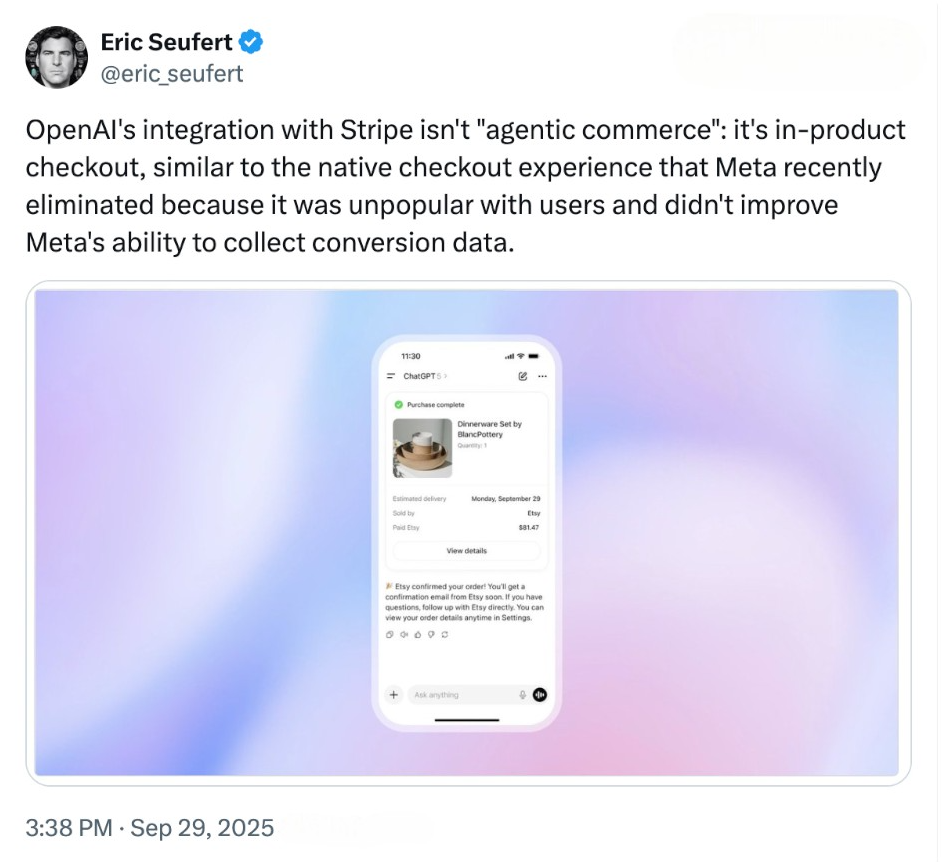
I made the point when OpenAI first announced Instant Checkout that the product bore no resemblance to what most people probably understand ‘agentic commerce’ to mean: Instant Checkout simply surfaced product recommendations in chat and monetized them with an affiliate fee. If Instant Checkout didn’t represent agentic commerce, using that term to describe Meta’s new ‘purchase-from-an-ad’ experience is simply absurd. An agent plays no role in this transaction: a user sees an ad and clicks a button to make a purchase. This workflow merely resurrects the social commerce model Meta had previously abandoned, with no agent involved whatsoever. The fact that this interaction format is being classified as agentic commerce underscores how diluted, distorted, and devoid of analytical rigor that phrase has become.
And it probably also highlights the weakness of the ‘agentic commerce’ mental model and the indomitability of behavioral advertising as the primary mechanism of product discovery. I have no idea whether this form of social commerce will work where Facebook and Instagram Checkout failed. I also see this as primarily an attack on Amazon’s Buy Now functionality, in that it collapses the path from discovery to purchase into a single interface, not an innovative new approach to consumer checkout.
Comments: