
OpenAI should know better

The Information reports that OpenAI is launching its advertising product without advanced targeting or measurement tools, with CPM billing, and at a premium price point (emphasis mine):
OpenAI won’t be providing detailed information about the query responses accompanying their ads or whether ads prompted ChatGPT users to take an action, like buying something or looking up a website. OpenAI could introduce that data over time, but it will need to incorporate more-sophisticated ad tools that could take time to set up … Advertisers will get high-level insights like total ad views, an OpenAI spokesperson confirmed. That’s similar to what TV networks offer … For its initial ads, which will appear below ChatGPT responses, OpenAI is targeting a price of roughly $60 for every 1,000 views an ad gets, the buyer said. That rate is on par with targeted streaming and premium TV inventory such as live NFL games, analysts say. Meta’s cost per 1,000 views, by comparison, is typically less than $20.
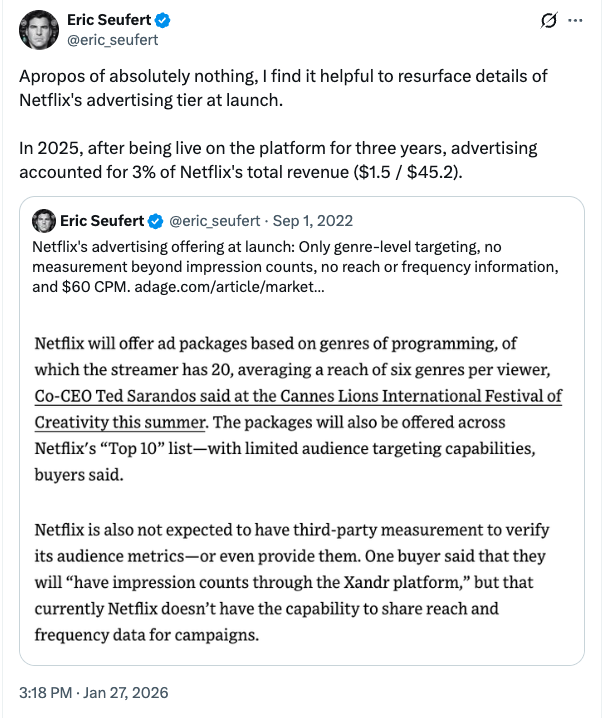
Long-time MDM readers might expect a critical reaction to such an austere, spartan advertising product. After all, I questioned whether Netflix could command premium advertising pricing when it launched its ad-supported tier, given the platform’s immaturity. I was also consistently skeptical that Netflix’s ad-supported tier would be ARPU-neutral, as the company claimed, given its underwhelming targeting and measurement tools, which would prevent direct response advertisers — the prized, aspirational clients for any digital advertising platform — from investing heavily.
My circumspection regarding Netflix’s advertising business stemmed from the lack of sophistication of its targeting, measurement, and optimization infrastructure; being yoked to Xandr, its technology launch partner, simply prevented the company from implementing the best practices (or even table stakes) that direct response advertisers have come to expect.
And I was equally dubious of the prospects for Perplexity’s advertising offering at launch, which similarly operated on CPM pricing. My skepticism was compounded by the fact that keyword-based advertising in a chatbot could engender an outcome misalignment with users, as I articulated in Perplexity introduces advertising; exploring the AI-search incentive problem (emphasis new):
This reality renders Perplexity’s ad product more suitable for brand advertising than direct response … Which is exactly what it appears that Perplexity is building. The company plans to bill on a CPM basis and offer targeting against broad categories like “health and pharma” and “home and garden.” Further, per the advertising deck, the company will offer advertisers access to eight metrics, such as “total queries in a category, number of queries that met criteria for an ad to show up, impressions delivered, unique impressions, click volume for sponsored media, sponsored related questions and website links.” The company hasn’t announced any third-party measurement partnerships yet … Putting aside the apparent immaturity of Perplexity’s advertising offering at launch, it’s not clear that direct response search advertisers — optimizing against immediate conversions and pricing those for down-funnel metrics — could possibly see the same quality of return on a placement that doesn’t necessitate an outbound click or capitalize on the aforementioned tension between monetization and retention. Applying the traditional search advertising business model to AI search strikes me as misguided; these tools feature wholly distinct engagement models, and AI search presents an incentive misalignment problem for advertisers that could result in the format’s inappropriateness for direct response.
OpenAI’s initial advertising offering resembles that of Perplexity, which seems to have either deprioritized or completely abandoned the project, and of Netflix, which was initially unsuccessful with the endeavor but eventually pivoted its strategy into something more workable. And yet, I do believe that OpenAI’s advertising initiative will be successful, and that this limited functionality (including CPM billing) will merely serve as a short-term stop-gap phase until the company can build out the tools and infrastructure it needs to deliver direct response outcomes to SMBs.
I believe this because OpenAI, perhaps more than any other large consumer technology company, should know better. As I note in Obviously, OpenAI will monetize with ads, published last May, OpenAI possesses deep advertising product domain expertise, which was buttressed when the company acquired Statsig in September 2025.
And the reality is that OpenAI’s advertising business has to start somewhere; the product will evolve over time as the company introduces conversion collection mechanisms like a pixel and a CAPI and aggregates more data for use in optimization and targeting. Further, as I wrote in ChatGPT’s Instant Checkout is an advertising data feed, I believe that the affiliate model that ChatGPT is utilizing for Instant Checkout is really just a stalking horse for collecting conversion data that can be used to build behavioral profiles for its users that can be repurposed for advertising to more lucrative effect.
It strikes me as infeasible that any company could launch a fully-featured advertising platform ex nihilo, without guiding its development with increasingly scaled usage. In other words: it’s not possible to merely intuit the various settings of an end-to-end conversion-optimized advertising product. These systems require scale to achieve efficiency; by definition, an advertising platform can’t optimize targeting on the basis of conversions without access to a (large) volume of conversion data. OpenAI’s CPM-billed, no-frills advertising offering is very likely designed to bootstrap the data and usage needed to evolve it into something vastly more valuable and performant. The reason OpenAI is charging $60 CPMs in an introductory phase is that brand advertisers will pay that for the novelty factor and the proximity to cultural relevance.
OpenAI should know better. And the team there likely does. If OpenAI’s advertising platform doesn’t evolve meaningfully in six to twelve months to include conversion-optimized targeting and vastly better measurement, I’ll be skeptical of its success. But until then, given the high density of ex-Meta employees working for the company, I’m willing to give OpenAI the benefit of the doubt. While commercial traction is by no means guaranteed and will be hard won, OpenAI’s advertising bona fides are substantial, and its success with advertising is easier to rationalize ex ante than other companies that have charted this course.
Comments: